By Raajje24 Political Desk | Feature Satire
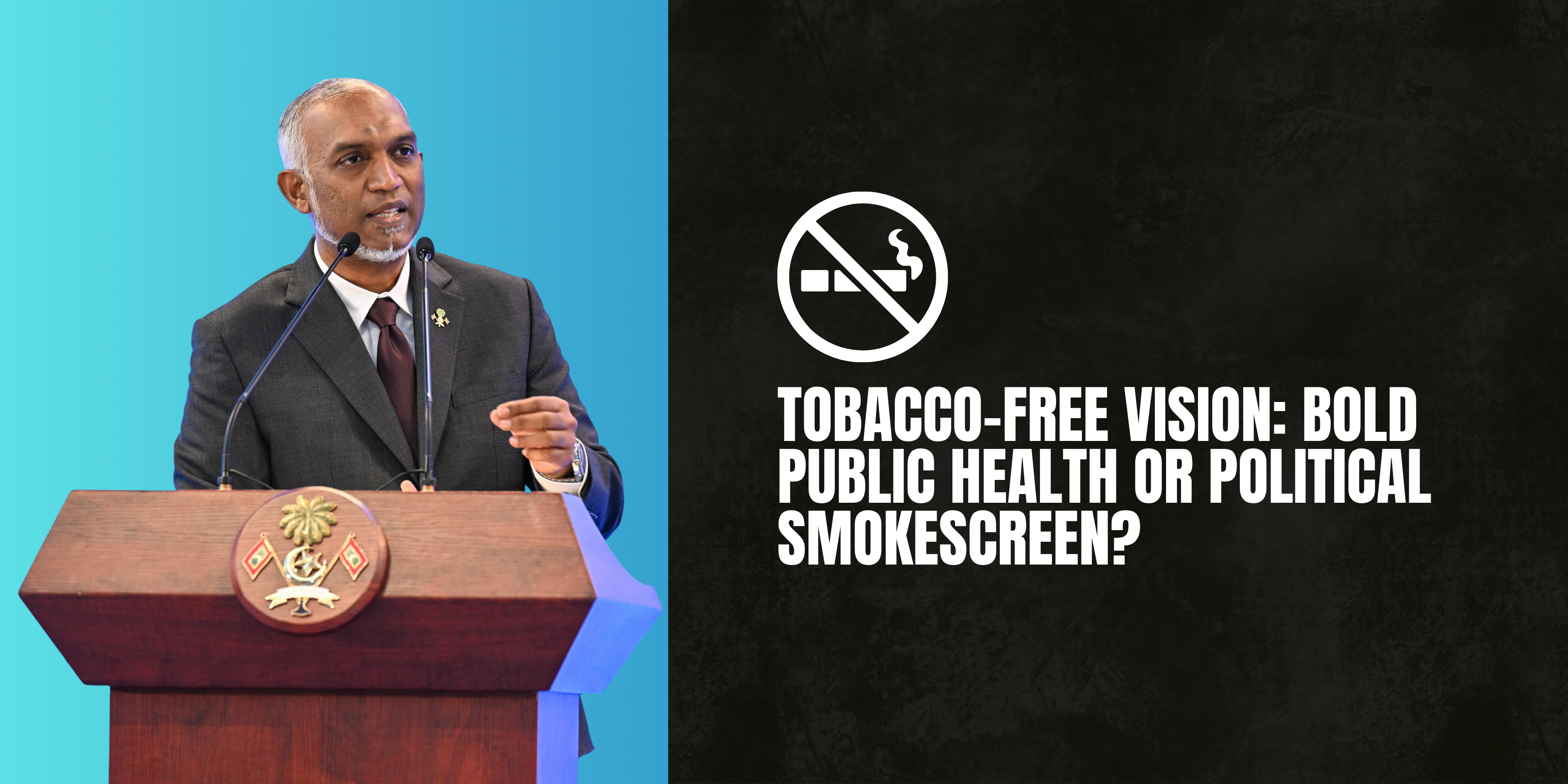
In a nation often clouded by political turbulence and economic strain, President Dr Mohamed Muizzu has lit a new flame—this time, against tobacco.
In what could be described as one of the most ambitious public health campaigns in Maldivian history, the President has directed his Cabinet to explore offering financial rewards to entire island communities that successfully achieve a complete end to tobacco use. According to a statement posted on his official X (formerly Twitter) account, the proposed plan would see cash incentives deposited directly into the bank accounts of all residents on qualifying islands.
The initiative is framed around a simple equation: Quit smoking, get rewarded. And in a country where many struggle with the rising cost of living, the offer sounds tempting. For some, it’s a public health breakthrough. For others, it raises a familiar question—is this a bold reform, or a calculated distraction?
A Health-First Administration?
President Muizzu has repeatedly positioned himself as a reformist with an eye on long-term transformation. His tobacco policy, which includes a wide array of legislative and executive measures, aligns with his government’s broader vision of a “healthier, tobacco-free Maldives.”
Just last month, he ratified the second amendment to the Tobacco Control Act (Law No. 15/2010)—a generational ban that will take effect in November 2025. Under the amendment, individuals born on or after January 1, 2007, will never be allowed to legally purchase tobacco products, effectively phasing out the next generation of smokers.
The government’s efforts don’t stop there:
-
The legal purchasing age for tobacco has been raised to 21.
-
Tobacco advertising, promotions, and sponsorships are now banned.
-
Taxes on tobacco products have been significantly increased.
-
Tobacco-free zones are being expanded nationwide.
-
And most notably, import and possession of equipment used to manufacture e-cigarettes and vapes have been prohibited.
These sweeping measures earned international praise. On World No Tobacco Day 2025, the World Health Organization (WHO) honored President Muizzu with a special award for his leadership in tobacco control.

Between Vision and Reality
But even as health experts applaud the government’s direction, political observers are questioning the timing and practicality of the new financial reward scheme.
How will the policy be enforced across hundreds of inhabited islands? Who monitors “complete cessation”? What if one smoker ruins it for an entire island? More critically, how sustainable is this reward program—especially as the government faces economic pressures and mounting public debt?
Critics warn that while the campaign promotes a noble cause, it could also serve as a strategic PR move, shifting public focus away from other unresolved challenges—housing shortages, corruption concerns, stalled development projects, and youth unemployment.
“It’s easier to wage war on tobacco than to reform governance,” one opposition councilor told Raajje24, requesting anonymity. “But health policies shouldn’t become tools of political theatre.”
Public Support with Quiet Skepticism
Despite the political noise, many citizens seem to support the tobacco-free ambition, especially parents, health professionals, and religious scholars. Yet some are wary of the overreach and social tension the policy might cause—particularly in communities where tobacco use remains deeply ingrained in daily life.
There’s also concern about potential stigmatization and policing of behavior. “Will we start surveilling who smokes on the beach?” one Fuvahmulah resident asked online. “Will my neighbor report me to get their reward?”
A Test of Political Will
In essence, President Muizzu’s tobacco policy is both symbolic and substantial. It reflects a long-overdue prioritization of public health—but it also tests the government’s credibility, capacity, and political intent.
Will this be remembered as a defining reform in national health policy—or just another well-publicized initiative that fizzled under its own weight?
Either way, one thing is clear: The war on tobacco is on. And it’s not just about cigarettes—it’s also about trust, delivery, and the political legacy of a President who promises change.