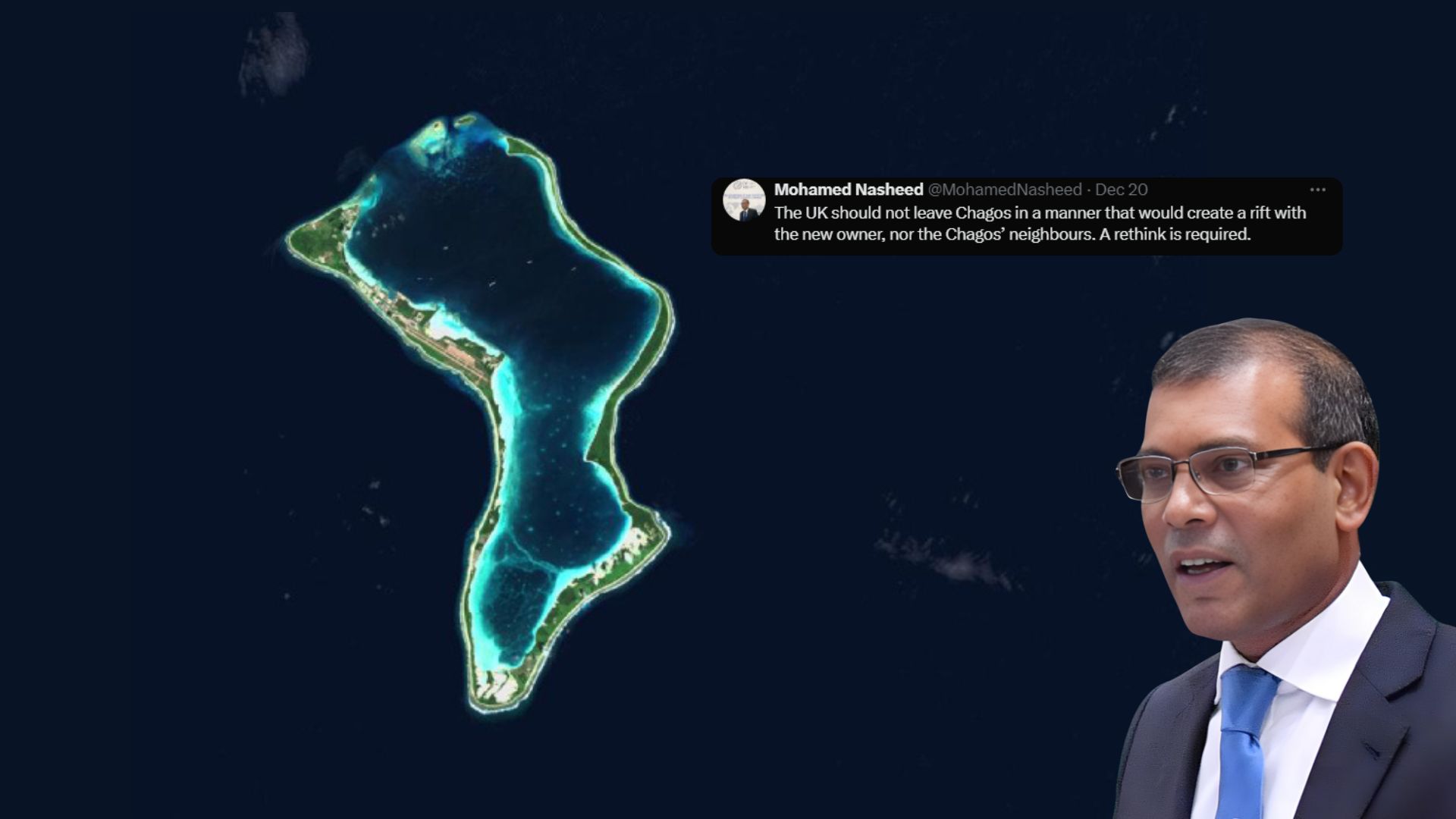
Malé, Maldives – Former Maldivian President Mohamed Nasheed has voiced concerns over the United Kingdom’s approach to transferring sovereignty of the Chagos Archipelago to Mauritius, calling for a reassessment to avoid regional tensions.
In a post on X, Nasheed stated, “The UK should not leave Chagos in a manner that would create a rift with the new owner, nor the Chagos’ neighbours. A rethink is required.” He also shared a link to an article from The Telegraph, highlighting the implications of the handover and urging British Prime Minister Keir Starmer to reconsider the process.
The UK should not leave Chagos in a manner that would create a rift with the new owner, nor the Chagos’ neighbours. A rethink is required.https://t.co/AglnKizLC6
— Mohamed Nasheed (@MohamedNasheed) December 19, 2024
The Chagos Archipelago, located in the Indian Ocean, has been at the center of a long-standing territorial dispute between the UK and Mauritius. In recent years, international legal bodies, including the International Court of Justice (ICJ), have ruled against the UK’s continued administration of the islands, calling for their return to Mauritius.
While the UK announced its decision to cede control earlier this year, concerns have grown over the potential consequences of the transfer. Mauritius’s new government, led by Prime Minister Navin Ramgoolam, has expressed dissatisfaction with the current terms of the agreement and called for renegotiations.
Nasheed’s remarks echo broader concerns in the region, including those of neighboring Maldives, which has previously raised reservations about the handover’s geopolitical and environmental implications.
The Chagos Islands hold significant strategic importance due to the joint UK-US military base on Diego Garcia, a key security hub in the Indian Ocean. The base’s future has been a focal point in discussions, alongside the unresolved plight of displaced Chagossians seeking the right to return to their homeland.
As the UK proceeds with its plans, Nasheed’s call for a “rethink” underscores the need for diplomacy and a balanced approach to ensure regional stability and cooperation.